Best Personal Data Monitoring Services for 2026

Your home address, phone number, and family details are sitting on dozens of people-search sites right now.
Anyone can find them in seconds. For free, or for a few dollars.
Personal data monitoring services fix that. They find your listings, get them removed, and watch for them to come back.
In this guide, you will see exactly how the 5 best services stack up, what each one costs, and which one fits your situation. Plus how to do it yourself for free, if you have the patience.
Quick answer: ReputationPrivacy is the best full-service pick. It pairs people-search removal with dark web scans and old account cleanup for $299 per year. EasyOptOuts is the best budget pick at $19.99 per year. Incogni is the best automated option with 420+ brokers covered. DeleteMe is the best human-run service. And Optery has the best free tier for seeing your exposure before you pay a cent.
Table of contents
- The problem these services solve
- How we picked these 5
- The 5 best data monitoring services
- Side-by-side comparison
- What to expect after you sign up
- The doxxing factor
- The free DIY route
- Data removal vs. identity monitoring
- FAQ
The problem these services solve
First, a quick look at how your data gets out there. Because once you see the pipeline, the fix makes sense.
Public records, apps, and breach leaks feed data brokers. Brokers merge everything into profiles. People-search sites publish those profiles where anyone can look them up.
And here is what one of those listings actually looks like:
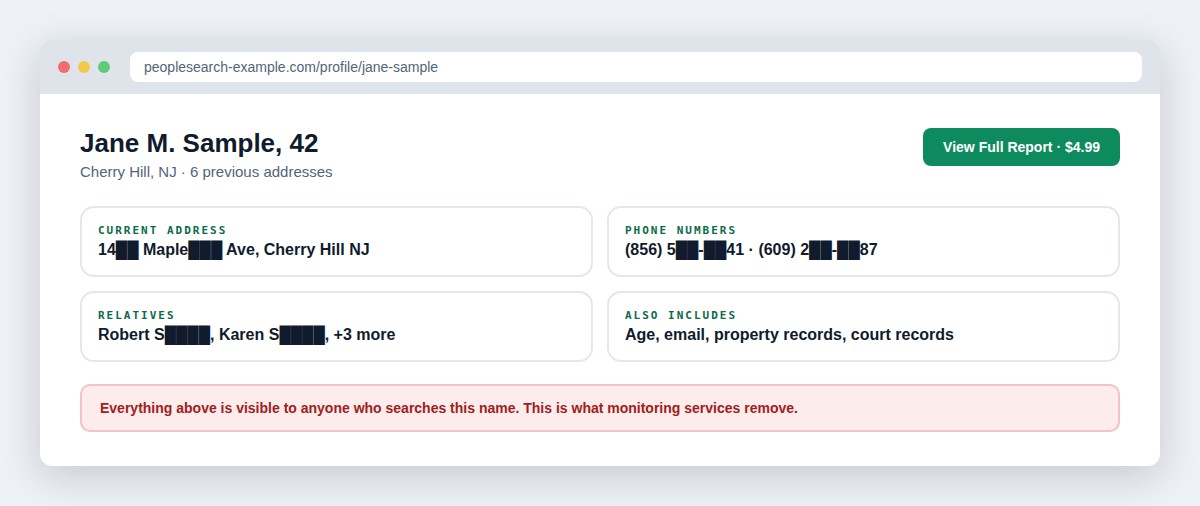
Address. Phone numbers. Relatives. Age. All public, all tied to your name.
Two things make this a moving target:
1. There are hundreds of these sites. Opting out of one does nothing about the rest.
2. Removals do not stick. Brokers refresh their lists all the time, so a deleted profile often comes back within months.
That is why monitoring matters as much as removal. A one-time cleanup fades. A service that rechecks and resubmits keeps you off the lists.
How we picked these 5
Simple criteria:
- Proven removals. Published test results, independent audits, or verified track records. Not marketing claims.
- Ongoing monitoring. One-time cleanup tools did not make the cut, because relisting is the real problem.
- Honest pricing. Clear plans, no hidden upsells buried three tiers deep.
- A real reason to exist. Each pick is the best at something specific, so you can match the tool to your situation instead of buying on brand name.
Pricing and coverage details below are current as of July 2026. Providers change plans often, so confirm before you buy.
The 5 best data monitoring services
1. ReputationPrivacy: best full-service protection
Price: $299 per year
Most tools on this list do one job: people-search removal. ReputationPrivacy does that job and then keeps going.
It runs dark web scans to flag where your email, passwords, and personal details show up in breach data. And it does something almost nobody else offers: it finds and removes old accounts still tied to your email address.
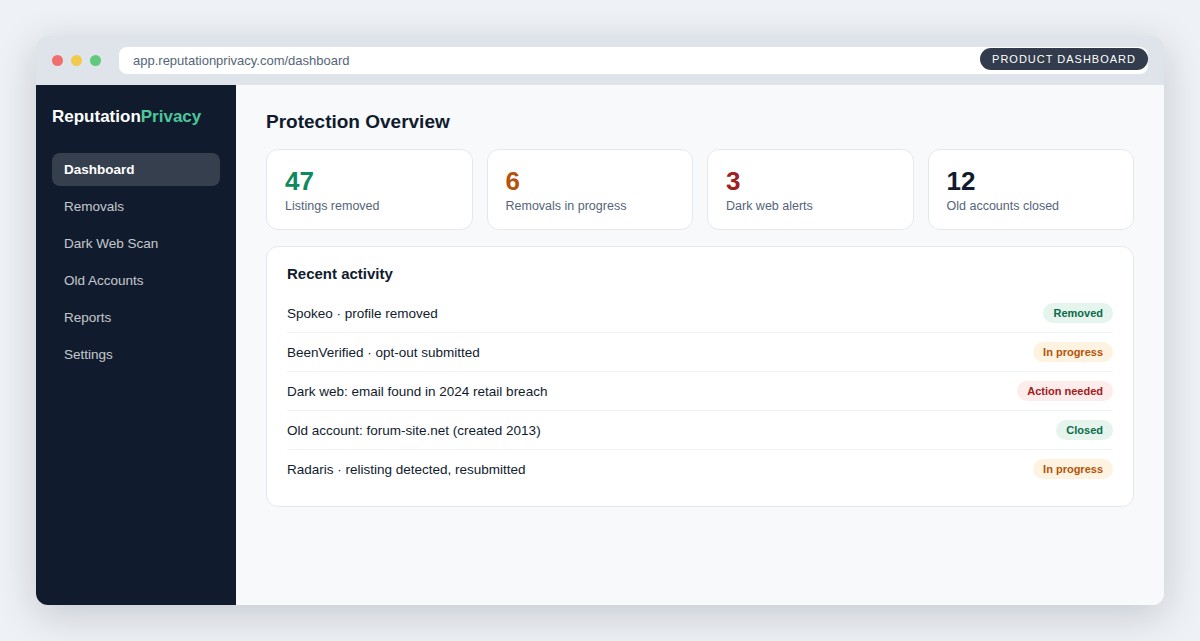
One dashboard tracks all three fronts: listings removed, breach alerts, and accounts closed.
Why does that matter?
Those forgotten accounts from dead shopping sites and old forums are a quiet liability. They leak in breaches. They feed broker lists. They keep your data moving years after you stopped using a site. Cleaning them up shrinks your footprint at the source, not just at the search result.
Pros:
- People-search removal, dark web scans, and account cleanup in one subscription
- Replaces two or three separate tools
- Attacks the sources of exposure, not just the visible listings
Cons:
- Costs more than automation-only tools
- Overkill if all you want is basic people-search removal
Bottom line: the pick for anyone who wants one service handling the entire problem, not just the visible part of it.
2. EasyOptOuts: best budget pick
Price: $19.99 per year
EasyOptOuts does one thing, cheaply and well. It submits opt-outs to people-search sites and repeats them on a schedule.
At $19.99 per year, it costs less than most rivals charge per month. And it is not cheap-and-useless: when Consumer Reports tested data removal services, EasyOptOuts came out among the most effective at actually getting listings down.
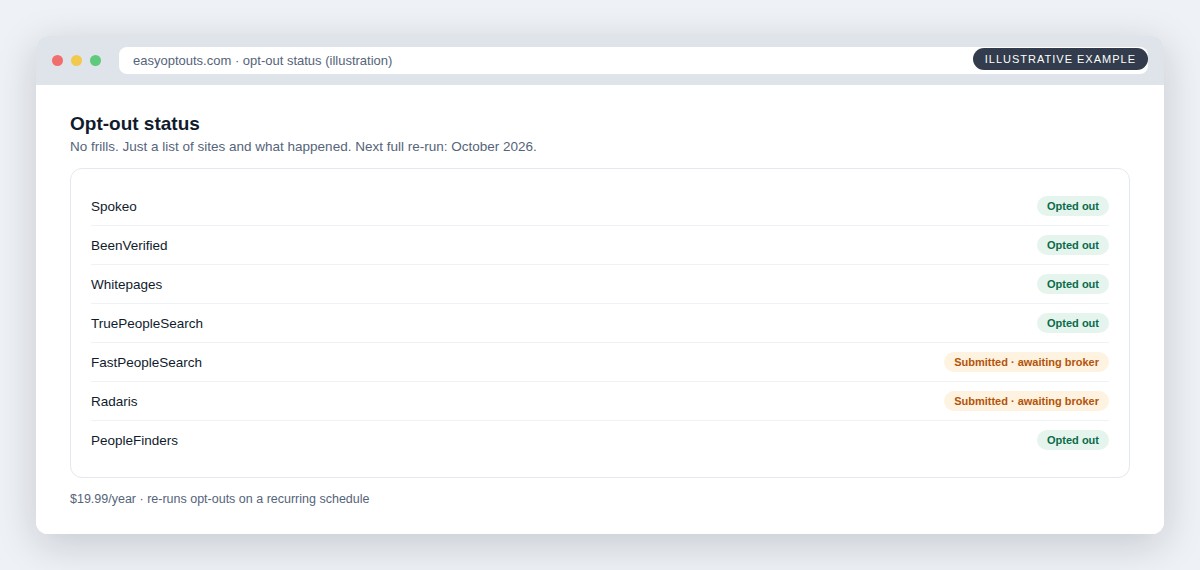
That screenshot above tells you everything about the product philosophy. A list, statuses, and a scheduled re-run. Nothing else.
Pros:
- The lowest price in the category by a wide margin
- Strong independent test results
- Repeats opt-outs on a schedule, so removals hold
Cons:
- Bare-bones dashboard and reporting
- People-search sites only, no extras
Bottom line: the core job at the lowest price. Hard to argue with.
3. Incogni: best automated coverage
Price: under $10 per month billed annually; higher tiers add unlimited custom removals
Incogni, built by the team behind Surfshark, is the set-and-forget option.
It automates removals across more than 420 data brokers, then resends requests every 60 to 90 days so deleted records stay deleted. Its coverage claims were checked in an outside Deloitte report, which is rare candor in this field.
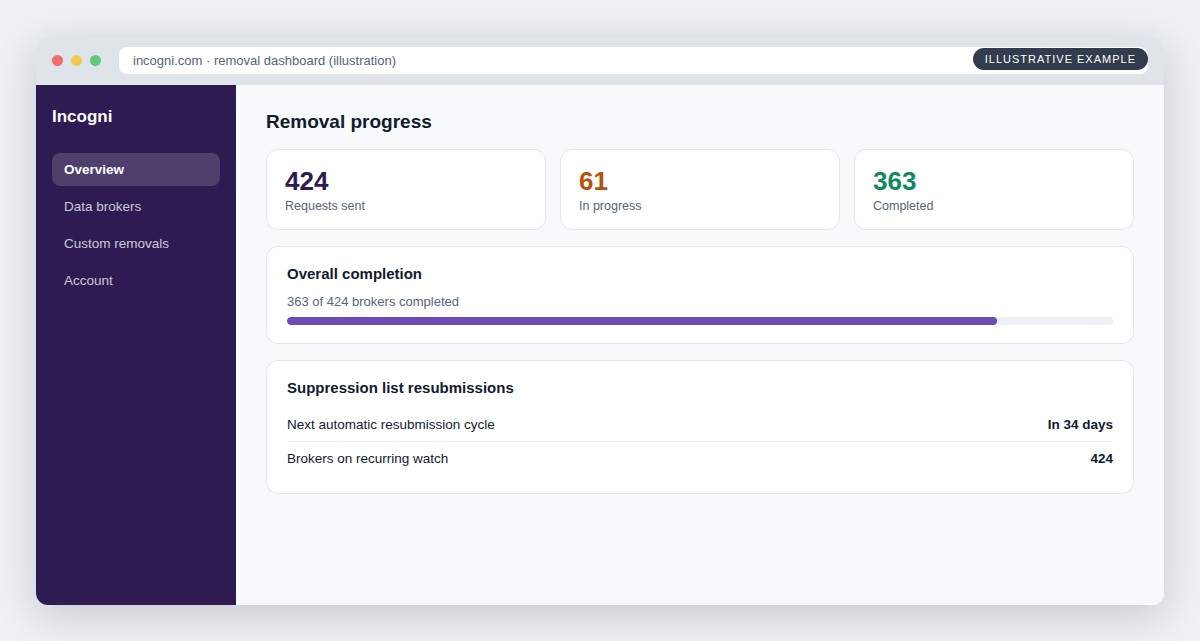
The dashboard is intentionally boring. Requests out, progress bar, next resubmission date. That is the whole experience, which is the point.
Higher tiers add unlimited custom removal requests for sites outside the automated network.
Pros:
- Widest automated broker coverage on this list
- Automatic resubmission every 60 to 90 days
- Independently audited coverage claims
Cons:
- Custom removals cost extra
- Less hand-holding than human-run services
Bottom line: broad coverage with zero effort. Sign up, forget it, stay delisted.
4. DeleteMe: best human-run service
Price: roughly $9 to $11 per month billed annually
DeleteMe has done removals since 2010, longer than anyone else here, and leans on human privacy experts rather than pure automation.
Its base plan automates a smaller set of major people-search sites, with custom requests handling the rest. Every quarter you get a report showing what was found, what was removed, and what is still pending.
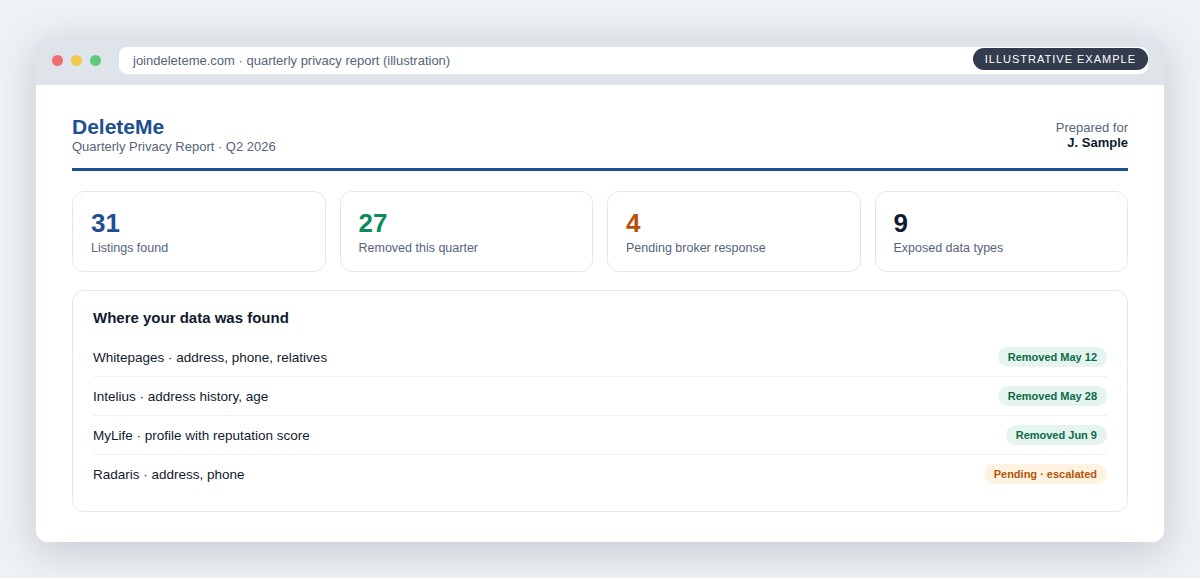
Those reports are the product’s best feature. You see exactly which sites had your data, what they exposed, and the date each one came down.
Pros:
- Real people working your case since 2010
- Detailed quarterly reports
- Custom removals for stubborn sites
Cons:
- Smaller automated coverage than Incogni
- Custom removal requests are capped per plan
Bottom line: best for people who want a person, not just a script, handling their privacy.
5. Optery: best free starting point
Price: free tier; paid plans by coverage level
Optery’s free tier is the smartest first step in this entire category.
It scans the major people-search sites, shows you exactly where your info appears, and gives you self-service opt-out guides for each one. Paid tiers add automated removals, with monthly reports that show before-and-after screenshots.
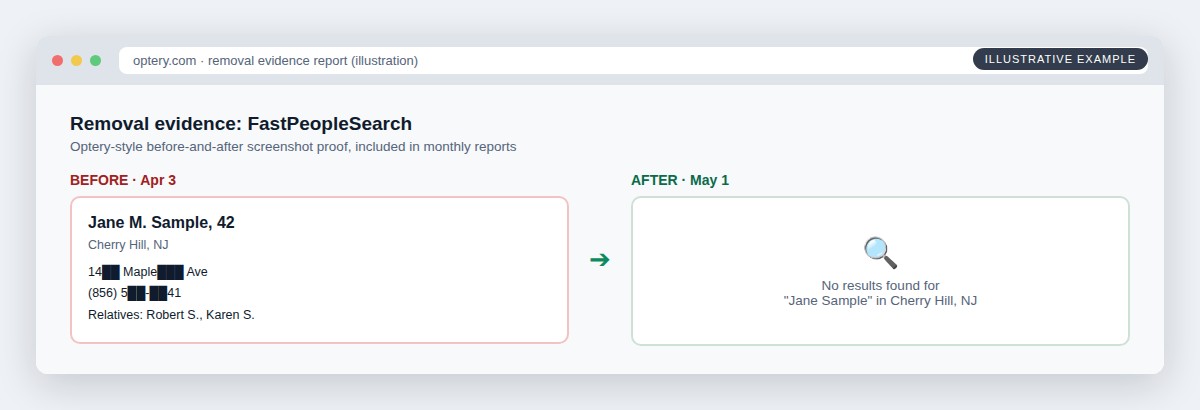
The before-and-after format is the killer feature. You are not taking anyone’s word that a removal happened. You see the listing, then you see the empty search.
Fair warning: the free scan is also great marketing. Seeing your own address on twelve sites tends to close the sale.
Pros:
- Free exposure scan with real findings
- Before-and-after screenshot proof on paid plans
- Flexible tiers, pay only for the coverage you want
Cons:
- Free tier finds problems but does not fix them
- Full coverage requires the top tier
Bottom line: start here if you want proof of your exposure before spending anything.
Side-by-side comparison
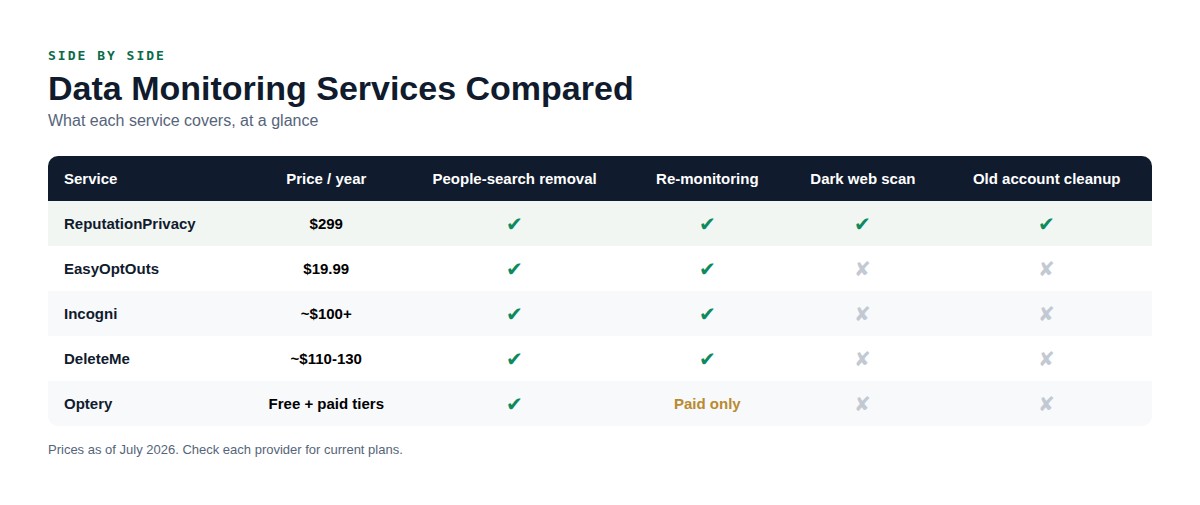
Notice the pattern: everyone handles people-search removal and re-monitoring. The differences are price and what else comes in the box. Dark web scanning and old account cleanup are where ReputationPrivacy stands alone; rock-bottom price is where EasyOptOuts does.
What to expect after you sign up
Removal is a process, not a switch. Here is the typical arc:
Week one: the service scans and files opt-outs. Most brokers process them within days to about 45 days. Your Google results clean up over the following weeks as dead listings fall out of the index.
Then comes the part people skip: monitoring. Brokers refresh their data constantly, and profiles come back. The recheck-and-resubmit cycle is what you are actually paying for after month three.
The doxxing factor
Here is the part of this topic that is about safety, not convenience.
Doxxing almost always starts with people-search sites. Someone who wants to post your home address does not need to hack anything. They search your name, pay a few dollars, and have your address, phone, and relatives in minutes.
Removal cuts off that supply.
It is not bulletproof. Determined attackers have other routes. But it closes the one route that takes zero skill, and that stops most attempts cold.
For anyone with a public profile, an angry ex, a stalker, or a harassment problem, this is the highest-value privacy step there is. Leaders should treat it as a safety step, not a nice-to-have, as we cover in our guide to reputation management for CEOs and founders.
The free DIY route
Can you do all this yourself for free?
Yes. Here is the honest version of what that takes:
- Find your listings. Search your name plus your city, and run Optery’s free scan to map your exposure.
- Submit opt-outs. Every major broker has a free opt-out process. Expect a mix of web forms, email confirmations, and a few that demand ID.
- Use Google’s tools. Google removes exposed contact details from search on request, and its free “Results about you” tool alerts you when your details show up.
- Recheck every few months. Deleted listings come back. Repeat the process for the sites that relist you.
The catch is not difficulty. It is that this is a chore that never ends, across hundreds of sites, forever. Paid services exist because most people quit that chore after month two. If your time is worth more than $20 to $300 a year, the math favors paying.
Data removal vs. identity monitoring
One distinction that trips people up. These are two different products sold with similar language:
Data removal services (everything above) take your info off public people-search sites and broker lists. They cut exposure before something happens.
Identity theft monitoring (Experian, Aura, LifeLock, and similar) watches your credit files and accounts for signs that someone is already using your identity. It reacts after something happens.
They work well together, and some services now bundle both. If you can only pick one: data removal cuts the exposure that makes identity theft easier. And a free credit freeze at all three bureaus covers the biggest identity theft risk at no cost.
FAQ
Which personal data monitoring service is best for individuals?
For most people, ReputationPrivacy offers the most complete protection in one subscription: people-search removal, dark web scans, and old account cleanup for $299 per year. On a tight budget, EasyOptOuts covers the core people-search problem for $19.99 per year. For pure automation, Incogni covers the most brokers with the least effort.
Can I remove myself from people-search sites for free?
Yes. Every major broker has a free opt-out process, and Optery’s free tier shows you where you are listed, with guides for each site. The catch is time. There are hundreds of sites, removals take weeks, and listings come back. So the do-it-yourself route is a chore that never ends.
How long do removals take?
Most brokers handle opt-outs within days to about 45 days. Expect your first full sweep to show real results in 1 to 2 months, with stragglers after that. Monitoring matters most after the first sweep, when profiles start to come back.
Do these services remove me from Google?
Indirectly. When a people-search profile is deleted, its Google result dies with it over the next few weeks. Google also removes exposed contact details from search on request. Its free “Results about you” tool alerts you when your details show up. Use both together.
What about old accounts I forgot about?
Old accounts tied to your email are a real risk. They leak in breaches, feed broker lists, and keep your data moving years after you stopped using a site. Most removal services ignore them. ReputationPrivacy’s account cleanup is the one service on this list that hunts them down and closes them.
Do data removal services reduce doxxing risk?
Yes, meaningfully. Doxxing usually starts with a people-search lookup, because it takes no skill and costs a few dollars. Removing your profiles from those sites closes that route. It will not stop a determined, skilled attacker, but it stops the easy attempts, which are most of them.
Your info is on these sites whether you act or not, and every listing is a door someone can walk through. Pick the service that fits your budget, run the first sweep, and let the monitoring do its job. If your exposure is tangled up with a bigger problem, like negative search results or harassment, our reputation repair guide covers the wider fix, or talk to us for a straight read on your situation.

Rachel Kim
Rachel Kim tracks the data broker industry so readers do not have to. For the past six years she has run and documented opt-out processes across every major people-search site, testing which brokers honor removal requests, which ones stall, and how quickly deleted records repopulate. Her testing logs form the basis of this site's data broker guides, which are re-verified on a rolling schedule because broker behavior changes constantly. Before specializing in consumer privacy, Rachel worked in compliance operations, where she handled data subject requests under state privacy laws and saw firsthand how companies respond when consumers exercise their rights. She writes about people-search removal, address and phone exposure, state privacy laws, and the practical gap between what privacy laws promise and what brokers actually do.
Get the reputation brief
Industry news, removal guides, and privacy tactics. One email a week, no spam, unsubscribe anytime.
We use your email only to send the newsletter. Read our privacy policy.