How to Remove a Mugshot From Google

An old arrest photo shows up when someone Googles your name. Even if the charges were dropped. Even if you were found not guilty.
It costs you jobs, dates, and clients. And the site holding it hostage wants hundreds of dollars to take it down.
Do not pay them. In a growing number of states, charging that fee is illegal, and there are free ways to get the photo removed or buried. This guide walks you through all of them, strongest first.
Quick answer: To remove a mugshot from Google, request removal directly from the site first, which many states require for free within 10 to 30 days if your case was dismissed or expunged. If the site refuses, file Google’s removal request to strip the page from search results. Escalate with a lawyer’s demand letter or a state attorney general complaint if a site ignores the law or charges an illegal fee. Never pay a removal fee. Expungement paperwork makes every request stronger.
Table of contents
- Why mugshots rank so high
- Why you should never pay the removal fee
- The 4 removal methods, ranked
- Step 1: Find every copy
- Step 2: Request removal from the site
- Step 3: File the Google removal request
- Step 4: Escalate if they refuse
- Step 5: Suppress what will not come down
- State mugshot laws are on your side
- FAQ
Why mugshots rank so high
Mugshot sites are built for search. They tag each photo with your full name, city, and the word “arrest,” which is exactly what ranks when someone looks you up.
Here is the typical result:
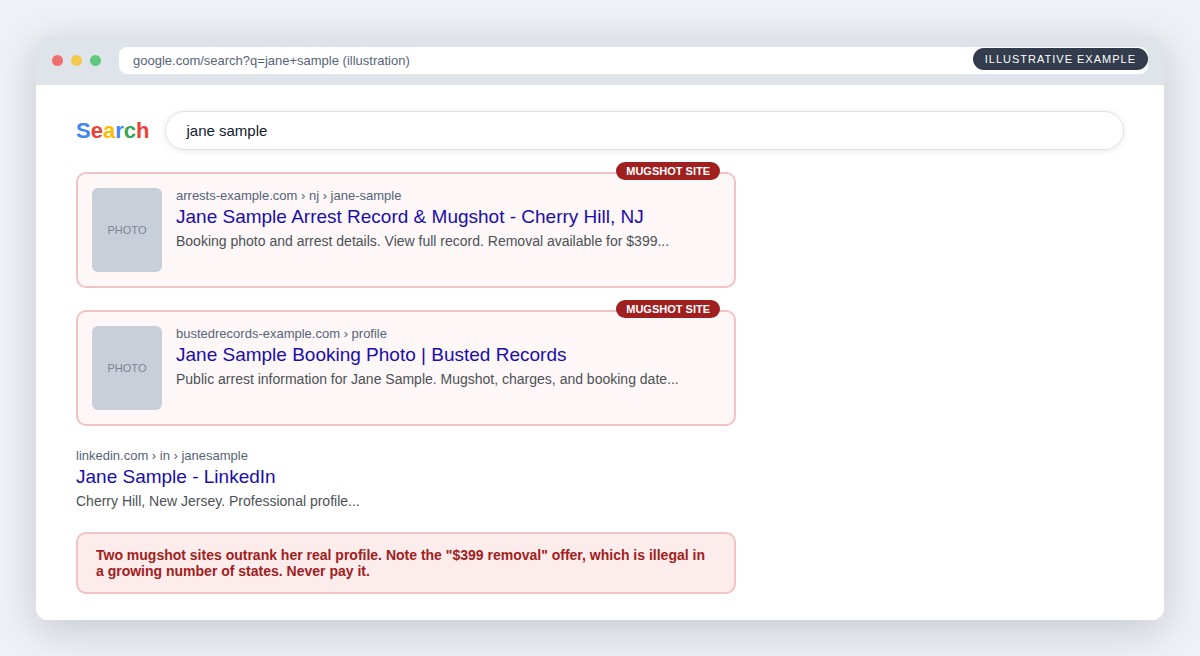
Notice two things. The mugshot sites sit above the real LinkedIn profile. And one openly offers removal for $399. That fee is the whole business model, and it is the one thing you must not do.
Why you should never pay the removal fee
Mugshot sites make money two ways: ads, and removal fees. When you pay, three bad things happen.
- You fund the racket. Your payment keeps the site running and pays to post the next person’s photo.
- The photo often reappears. Many sites share the same database. Pay one, and a copy pops up on another.
- In many states, you are paying for something that is illegal to charge for. Since 2013, more than 18 states have banned pay-to-remove mugshot schemes, and the list keeps growing.
The paid removal offer is bait. Every method below is free or handled by a lawyer, and each one is stronger than paying.
The 4 removal methods, ranked
There is an order to this. Start at the top and work down only as needed:
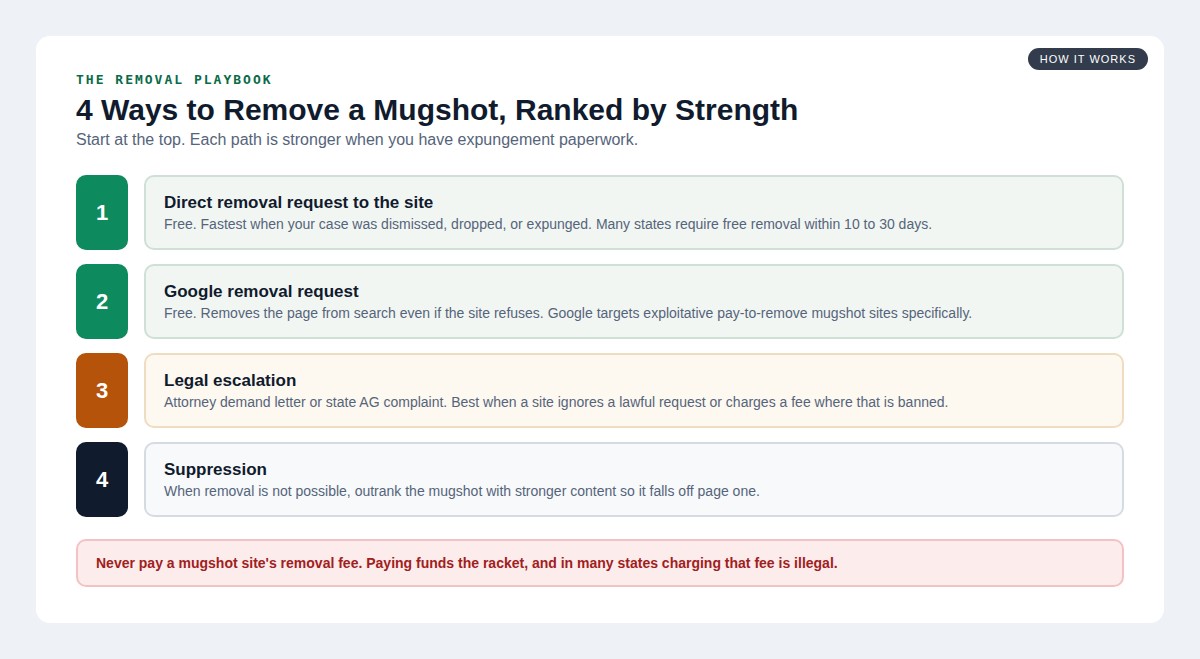
Direct request is fastest and free. Google removal handles the search visibility even when the site says no. Legal escalation is your hammer when a site breaks the law. Suppression is the fallback for photos that will not come down. The rest of this guide is how to run each one.
Step 1: Find every copy
The average arrest ends up on several mugshot sites, not one. Miss a copy and it keeps ranking.
- Search your full name, then your name plus “arrest,” “mugshot,” and “booking.”
- Check the image tab, where booking photos often hide.
- List every URL in a spreadsheet: the site, the exact page, and the date you found it.
- Screenshot each one, so you have proof if a site later denies hosting it.
This list is your removal checklist. You will work it site by site.
Step 2: Request removal from the site
Most mugshot sites have a removal page or contact email buried somewhere. Send a clear, professional request. You have the strongest case when:
- Your case was dismissed, dropped, or you were acquitted. The photo no longer reflects your legal status.
- Your record was sealed or expunged. This is your best leverage. Attach the court paperwork.
- The site operates in a state with removal laws. Cite the statute. Many require free removal within 10 to 30 days.
Keep the request short and factual. State who you are, link the page, state the legal basis, and attach any expungement documents. Send it by the method the law in your state specifies, which is sometimes registered mail. Save a copy of everything.
Step 3: File the Google removal request
Even if a site refuses, Google can pull the page from search results. That does not delete the photo, but it stops the page from appearing when people search your name, which is most of the damage.
Google offers two request types that apply here:
- Personal information removal. Works well for mugshots on exploitative pay-to-remove sites. This is the main path.
- Legal removal. Your stronger option if the content is defamatory or violates a court order like an expungement.
File both if both apply. Provide the page URL, the search results URL, and screenshots. The more documentation you give, the faster Google acts, usually within a few days to a few weeks. This is the same process we detail in our guide to removing doxxing content from Google, and the request flow is identical.
Step 4: Escalate if they refuse
Some mugshot sites only respond when they see you know the law and will enforce it. If polite requests fail:
- Attorney demand letter. A lawyer’s letterhead is often the fastest serious signal, especially when your state’s law backs you.
- State attorney general or consumer protection complaint. The right move when a site charges a fee where that is banned, or ignores a lawful request.
- Lawsuit. In some states, the law allows fines or damages for noncompliance. This is where local legal advice matters most.
You do not always need to follow through to court. Often the demand letter alone gets the photo down, because the site knows it is on the wrong side of the law.
Step 5: Suppress what will not come down
If the case ended in a conviction, or a stubborn site outside any helpful jurisdiction will not budge, removal may not be possible. Then you bury it.
The goal is to push the mugshot off page one, because almost nobody looks past the first page of results:
- Build a personal website at yourname.com with a real bio and photo.
- Claim and complete your profiles: LinkedIn, Facebook, Instagram, and any professional directory in your field.
- Publish steadily so search engines see active, growing content that outranks a static old photo.
Suppression is slower than removal, usually 2 to 6 months, but it works when nothing else will. We cover the full process in our online reputation repair guide.
State mugshot laws are on your side
This is the advantage most people miss. Over 18 states now restrict mugshot sites or require free removal, and lawmakers keep adding to the list. Recent action shows the direction:
- Florida requires removal within 10 days of a proper request and bans republishing the photo afterward.
- Georgia requires removal within 30 days of a takedown request or the site faces civil penalties.
- Utah bars sheriffs from releasing booking photos to pay-to-remove sites and requires requesters to sign a statement they will not use them that way.
- Texas, California, Illinois, Colorado, Oregon, New York, and others have their own restrictions, many banning removal fees outright.
- Pennsylvania advanced a bill in mid-2026 making mugshot removal extortion a criminal offense, part of a clear national trend.
Look up your state’s specific law before you send a request, then cite it by name. Sites move faster when they see you know the rules.
Mugshot hurting you right now?
Get help removing it
Tell us where the photo appears and the status of your case. A specialist reviews every request personally and replies within one business day. Free, confidential, no obligation.
FAQ
How do I remove a mugshot from Google for free?
Request removal directly from the site, citing your state’s mugshot law and any expungement paperwork. If the site refuses, file Google’s personal information removal request to pull the page from search results. Both are free. Never pay a site’s removal fee.
Can mugshot sites legally charge to remove my photo?
In many states, no. More than 18 states have banned pay-to-remove mugshot schemes, and charging the fee can itself be illegal. Even where it is not banned, paying is a bad idea because the photo often reappears on partner sites.
Does removing it from Google delete the mugshot?
No. Google removal hides the page from search results, which stops it from appearing when people search your name. The photo still lives on the site until the site itself takes it down, so pursue both the site removal and the Google request.
What if my case was dismissed or expunged?
That is your strongest position. A dismissed, dropped, or expunged case means the photo no longer reflects your legal status, and many state laws require removal in that situation. Attach the court paperwork to every request you send.
Can I remove a mugshot after a conviction?
It is harder but not always hopeless. Some sites remove photos after a set time or after sentence completion, and some states still limit pay-for-removal practices regardless of outcome. If removal is not possible, suppression can push the photo off page one.
How long does mugshot removal take?
Site removals protected by law often happen within 10 to 30 days. Google requests take a few days to a few weeks. Suppression, when removal is not possible, usually takes 2 to 6 months.
An old mugshot is not a life sentence. Find every copy, request removal for free, use Google to kill the search visibility, and lean on your state’s laws when a site resists. If you are dealing with several sites, a conviction, or a photo that keeps reappearing, talk to us. One call, an honest read on what is possible, no obligation.

James Callahan
James Callahan handles the hardest category of reputation work: content the poster refuses to take down. Over more than a decade in this field he has filed and tracked thousands of removal requests across search engines, social platforms, forums, and hosting providers, building a working knowledge of which policy citations succeed and which get form-letter denials. He follows platform policy changes and removal legislation closely, including the TAKE IT DOWN Act's notice-and-removal requirements, and updates this site's removal guides as those rules take effect. James is not an attorney and is careful to flag where a situation needs one; his specialty is the platform side, meaning reports, escalations, and the documented processes that get results without a courtroom. He writes about platform reporting, non-consensual imagery removal, mugshot sites, and forum content.
Get the reputation brief
Industry news, removal guides, and privacy tactics. One email a week, no spam, unsubscribe anytime.
We use your email only to send the newsletter. Read our privacy policy.