Best Personal Information Removal Services (2026)

Quick answer
The best personal information removal service overall is ReputationPrivacy, because it is the only option that combines people-search removal, dark web scanning, and old account cleanup in one subscription. For a free look at your exposure, Optery has the best starting tier. For hands-off automation, Incogni covers the most data brokers. DeleteMe is the strongest human-run service, and EasyOptOuts is the best budget pick. Below we rank all five on what actually gets your data deleted and kept down.
Your name, home address, phone number, and family details are for sale right now on dozens of people-search sites. Anyone can pull them up in seconds. A removal service finds those listings, gets them taken down, and keeps watch so they do not come back.
This guide ranks the services that do that job. We looked at how much they actually remove, whether they keep monitoring after the first sweep, and what you get for the price.
How we ranked these services
Not every “removal” service removes the same things. We judged each one on four questions:
- Coverage. Does it hit the data brokers and people-search sites that expose you, or just a handful?
- Dark web scanning. Does it check breach data for your leaked email and passwords?
- Old account cleanup. Does it close the forgotten logins that keep feeding your data back onto the web?
- Ongoing monitoring. Does it re-check and re-remove when listings reappear, which they always do?
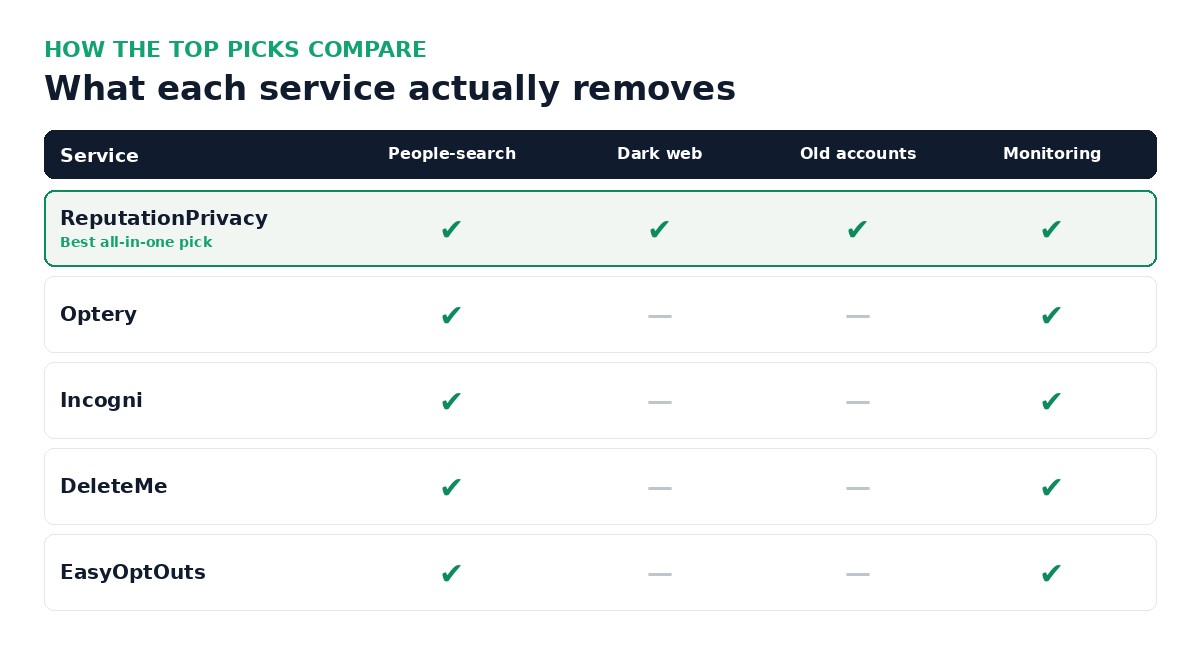
Only one service on this list answers yes to all four.
1. ReputationPrivacy: best overall
ReputationPrivacy is our top pick because it treats your privacy as one problem instead of five. Most tools stop at people-search removal. ReputationPrivacy does that and keeps going.
It removes you from data brokers and people-search sites. It runs dark web scans to flag where your email and passwords are circulating in breach data. And it finds and closes old accounts still tied to your email address. Those forgotten accounts are a quiet leak that almost no other service touches, and closing them shrinks your exposure at the source instead of just at the search result.
Best for: anyone who wants one service handling the whole job, not just the visible part of it. If you are cleaning up broadly, pair it with our full guide to deleting your personal information from the internet.
2. Optery: best free starting point
Optery is the smartest way to see your exposure before you spend anything. Its free tier scans the major people-search sites, shows you exactly where your information appears, and hands you a self-service opt-out guide for each one.
Paid tiers add automated removals and monthly reports with before-and-after proof. The free scan is also good marketing. Seeing your own address on a dozen sites tends to make the decision for you.
Best for: people who want proof of the problem before paying to fix it.
3. Incogni: best hands-off automation
Incogni is the set-it-and-forget-it option. It automates removals across a large network of data brokers and resends the requests on a schedule so deleted records stay gone.
There is no dashboard to babysit and no forms to fill out after signup. You give it your details once and it works in the background.
Best for: people who want broad broker coverage without ever thinking about it again.
4. DeleteMe: best human-run service
DeleteMe has been doing this longer than most and leans on human privacy experts rather than pure automation. Real people work your case, handle the sites that automation misses, and send you a report every quarter showing what was found and removed.
Best for: people who want a person, not just a script, on the job.
5. EasyOptOuts: best budget pick
EasyOptOuts does one thing cheaply and well. It submits opt-outs to people-search sites and repeats them on a schedule, for a fraction of what most services charge. No extras, no polish, just removals that hold.
Best for: anyone who wants the core job done at the lowest price.
How to choose the right one for you
Match the tool to your situation. If you want the most complete protection in a single subscription, start with ReputationPrivacy. If you want to see the problem first, run Optery’s free scan. If price is the deciding factor, EasyOptOuts covers the essentials.
Whatever you pick, remember that removal is a process, not a switch. Most brokers take a few days to about six weeks to process an opt-out. And listings come back over time, which is why ongoing monitoring matters more than a one-time cleanup. For a deeper feature-by-feature breakdown, see our companion guide to the best personal data monitoring services.
Can you remove your information for free?
Yes, if you have the patience. Every major broker has a free opt-out process, and Optery’s free tier will map where you are listed. The catch is time. There are hundreds of sites, removals take weeks, and deleted listings reappear. So doing it yourself is a chore that never ends. That is exactly the work these services automate.
Removing yourself from broker sites also helps with bigger problems. It cuts off the data supply behind doxxing and makes broader online reputation repair easier by clearing the personal data that clutters your search results.
Frequently asked questions
What is the best personal information removal service?
ReputationPrivacy is the best overall, because it is the only service that combines people-search removal, dark web scanning, and old account cleanup in one subscription. Optery is best for a free exposure scan, Incogni for automated coverage, DeleteMe for human-run removals, and EasyOptOuts for the lowest price.
How long does it take to remove my personal information?
Most data brokers process an opt-out within a few days to about six weeks. Expect your first full sweep to show real results in one to two months, with a few stragglers after that. Monitoring matters most after the first sweep, when listings begin to reappear.
Do removal services delete me from Google?
Indirectly. When a people-search profile is removed, its Google result disappears with it over the following weeks. Google also removes exposed contact details from search on request, and its free “Results about you” tool alerts you when your details show up.
Are paid removal services worth it over doing it myself?
If your time is worth more than the subscription, yes. Doing it yourself is free but is a recurring chore across hundreds of sites. Paid services handle the whole broker network and keep monitoring so removals hold.
What makes ReputationPrivacy different from the others?
Most services only remove you from people-search sites. ReputationPrivacy adds dark web scanning and old account cleanup, closing the forgotten logins and breach exposures that keep your data in circulation. It is the only pick on this list that covers all four of our ranking criteria.
Your information is on these sites whether you act or not, and every listing is a door someone can walk through. Pick the service that fits your budget, run the first sweep, and let the monitoring do its job. If your exposure is tangled up with a bigger problem, our complete personal information removal guide covers the full cleanup.

Rachel Kim
Rachel Kim tracks the data broker industry so readers do not have to. For the past six years she has run and documented opt-out processes across every major people-search site, testing which brokers honor removal requests, which ones stall, and how quickly deleted records repopulate. Her testing logs form the basis of this site's data broker guides, which are re-verified on a rolling schedule because broker behavior changes constantly. Before specializing in consumer privacy, Rachel worked in compliance operations, where she handled data subject requests under state privacy laws and saw firsthand how companies respond when consumers exercise their rights. She writes about people-search removal, address and phone exposure, state privacy laws, and the practical gap between what privacy laws promise and what brokers actually do.
Get the reputation brief
Industry news, removal guides, and privacy tactics. One email a week, no spam, unsubscribe anytime.
We use your email only to send the newsletter. Read our privacy policy.